
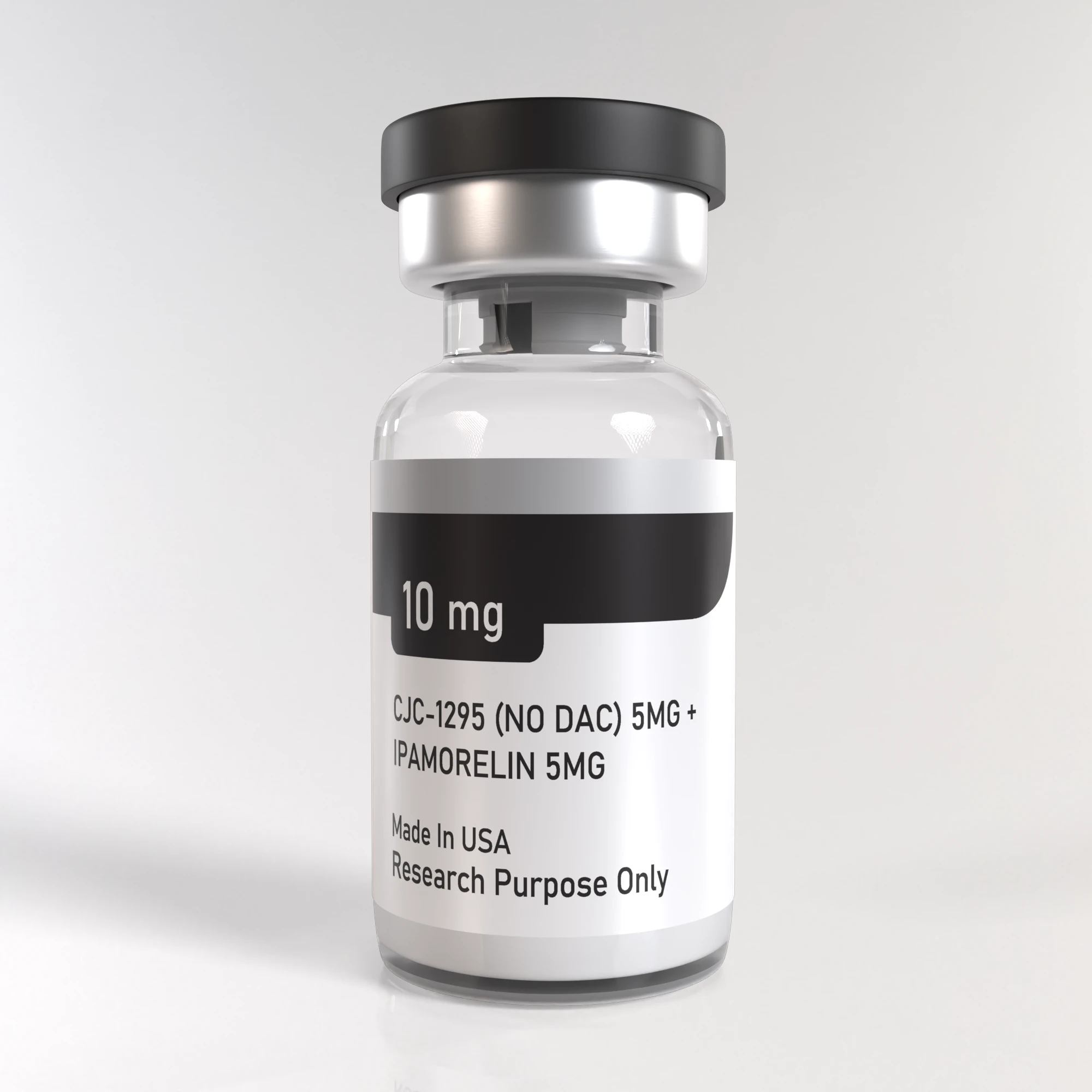

CJC-1295 (No DAC) 5MG + IPAMORELIN 5MG
CJC-1295 and ipamorelin are synthetic peptides used in academic and pharmaceutical research settings. This combination is designed for researchers working on studies related to growth hormone secretion, tissue regeneration, and peptide-based biological research. The “no DAC” formulation excludes des-amidated analogs, which may affect stability and activity profiles in specific experimental contexts.
Research Context
CJC-1295 (a non-acylated analog of GHRH) and ipamorelin (a growth hormone-releasing peptide) have been studied extensively for their role in modulating growth hormone (GH) and insulin-like growth factor-1 (IGF-1) secretion. CJC-1295 exhibits prolonged activity compared to traditional GHRH variants, often used in preclinical models to investigate GH secretion dynamics under controlled conditions. Ipamorelin, a selective GH-releasing hormone analog, is particularly valued for its specificity and minimal off-target effects in research applications.
Research Overview
These peptides are commonly used in in vitro studies assessing hormone secretion, in vivo models evaluating tissue regeneration, and pharmacokinetic research to investigate peptide stability and metabolism. Due to their distinct mechanisms—CJC-1295 targeting the GHRH receptor directly while ipamorelin engaging a GH-releasing pathway—the combination offers complementary insights for researchers studying endocrinology, metabolism, and regenerative biology.
Key Research Focus Areas
- Growth hormone and IGF-1 axis regulation under controlled experimental conditions.
- In vitro studies on peptide receptor activity and signal transduction pathways.
- Preclinical models investigating tissue regeneration, muscle growth, or wound healing.
- Pharmacokinetics and metabolic clearance of GHRH analogs in animal models.
- Comparative analysis of peptide stability and bioavailability in research settings.
Safety and Compliance
This product is intended solely for research purposes in a regulated laboratory environment. Researchers must adhere to institutional guidelines, handle peptides with sterile techniques, and ensure proper disposal of biological waste. As with all peptide reagents, formulation purity, storage stability, and experimental protocols should be validated according to research standards. Due to the biological activity of these compounds, improper handling may pose risks to laboratory safety and research integrity.
For research use only. Not for human or animal consumption.
Reviews
There are no reviews yet.